.svg)


.webp)
One Date, Two Tabs. Your Hotel Commercial Strategy Pays Twice.

Not every struggling hotel needs a complete overhaul. Sometimes, the difference between underperformance and market leadership comes down to fixing small but critical revenue leaks that quietly drain profitability.
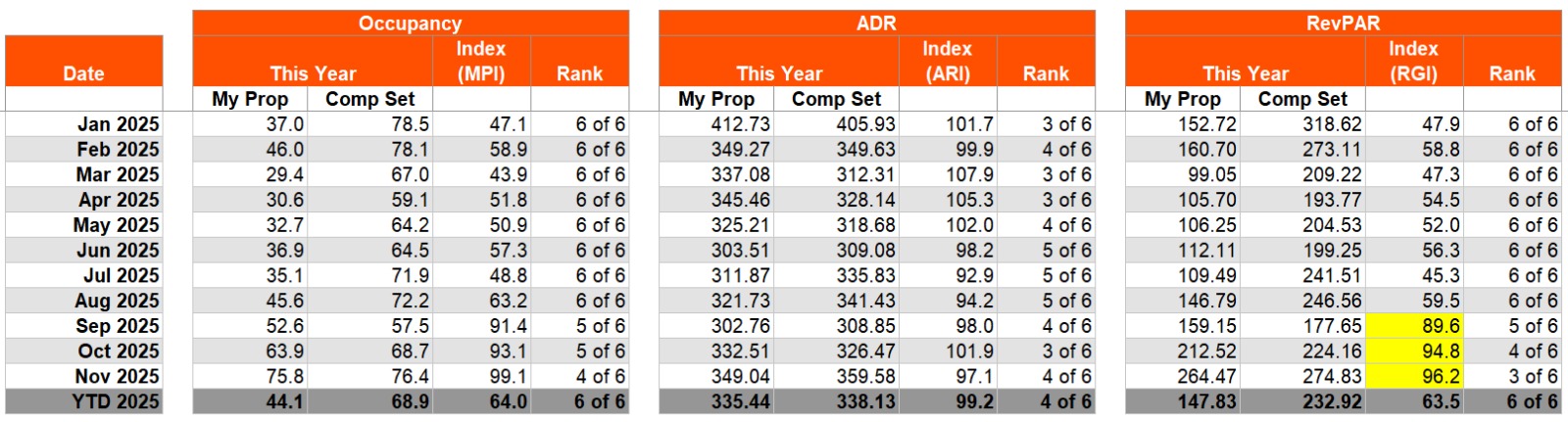
A newly opened luxury flagship property in Southeast Asia learned this firsthand. Despite launching with an exceptional product and prime location, the hotel couldn't break past the 50s in RGI (Revenue Generation Index) for ten months. The challenge wasn't structural it was strategic.
When we stepped in to guide their hotel revenue management in mid-July, we didn't implement dramatic changes. Instead, we focused on data-driven adjustments that addressed specific friction points. Within four months, the hotel was consistently hitting RGI levels in the 90s.
.webp)




The hotel positioned itself as a luxury property with rates above established global brands in its competitive set. While the product quality was exceptional, brand recognition became a barrier. Guests compared rates before experiencing the value, and the unknown brand couldn't command the premium it sought.
The Fix
We conducted a comprehensive SWOT analysis and worked with the commercial team to recalibrate the pricing strategy. Instead of leading with luxury positioning, we adopted an "earn the premium" approach starting competitively and letting performance drive rate increases.
Key Actions
Lower entry barriers widened the demand funnel. As conversion improved and reviews accumulated, the hotel gradually earned the right to luxury rates through demonstrated value rather than assumed brand equity.
Like many luxury properties, this hotel had less than 30% of inventory in the base room category. The remaining 70% was spread across multiple room types, but the price gaps between categories were inconsistent and didn't reflect actual guest willingness to pay. This created revenue friction some categories were overpriced while others left money on the table.
We built the room category pricing structure from the ground up using hotel revenue management best practices.
Key Actions:
There structured room type mix expanded the sellable inventory base, improved conversion across categories, and unlocked revenue that had been sitting dormant. Guests could now find appropriately priced options across the inventory spectrum
The hotel's performance marketing campaigns were efficient ROAS (Return on Ad Spend) was consistently strong. However, marketing budgets had remained static for months. The team hadn't tested whether they could scale spending while maintaining efficiency, leaving demand growth on the table.
We increased digital marketing investment significantly while closely monitoring performance metrics.
The result was straightforward: more qualified direct bookings without diluting returns. The hotel proved it could scale revenue profitably it just needed the confidence to invest behind what was already working.
The hotel was suffering from significant rate parity violations. The fornova rate parity score sat below 80, indicating serious distribution integrity issues. Wholesale partners and third-party resellers were undercutting the hotel's direct and OTA rates by 15-25% on average. These lower rates appeared prominently in meta search results and price comparison sites, making the hotel's official channels look overpriced. Guests were finding cheaper rates elsewhere, which undermined brand credibility and made OTA investments less effective. Rate leakage was quietly bleeding revenue and damaging market positioning.
We implemented a comprehensive rate parity monitoring and enforcement program to regain control of the hotel's rate integrity across all distribution channels.
Key Actions:
Through consistent monitoring and enforcement, the fornova rate parity score improved from below 80 to the high 80s. Restoring rate parity eliminated the confusion and price discrepancies that had been undermining official channels. Guests no longer found conflicting rates across different platforms, which improved trust and conversion. Most importantly, fixing parity created a level playing field that made subsequent OTA marketing investments far more effective, as the hotel was now competing on visibility and value rather than fighting against its own discounted inventory.
With rate parity now established, the hotel had a new opportunity: its OTA channels could finally compete effectively. However, the OTA marketing strategy remained conservative. Expedia Travel Ads was producing solid returns but stayed underfunded. Booking.com's visibility programs had minimal investment. The property was leaving qualified demand and market share on the table during critical need periods.
We shifted to an aggressive, performance-based OTA investment model, scaling budgets significantly now that rate integrity was no longer undermining returns.
Key Actions:
With rate parity protecting the hotel's positioning, OTA investments delivered immediate results. Broader visibility across platforms drove more qualified demand during softer periods, improved overall channel mix diversity, and reduced dependency on any single source. The hotel gained market share in key segments while maintaining healthy commission structures. Most critically, the ROAS remained strong because guests were no longer comparing official OTA rates against leaked wholesale pricing they were making booking decisions based on value, reviews, and visibility.
The Results: From Underperformance to Market Leadership
These five focused adjustments none requiring major capital investment or organizational restructuring took the hotel from RGI in the 50s to consistently touching the 90s within four months.
Key Performance Improvements:
The Lesson: Getting Back to Basics Delivers Results
Hotel underperformance rarely stems from one catastrophic flaw. More often, it's the accumulation of small decisions that gradually drift away from market reality. Whether it's pricing misaligned with brand equity, room type structures that restrict rather than amplify revenue, underfunded marketing channels with proven returns, rate parity violations that bleed revenue, or conservative OTA strategies each small fix compounds into significant impact.
In our experience at dhi Hospitality, we've encountered many complex situations requiring sophisticated solutions. Yet projects like this one remind us of something fundamental: sometimes the most powerful transformations come from returning to the core basics of revenue management. When you identify and correct these quiet leaks with intention and data, momentum builds quickly. The results speak for themselves they're a testament to getting the vital fundamentals right.
Ready to Unlock Your Hotel's Revenue Potential?
If your property is struggling with similar challenges underperforming RGI, rate parity issues, inefficient marketing spend, or unclear revenue strategies we're here to help.
Let's start a conversation about your property's specific situation and how we can work together to drive meaningful improvement.







.webp)